
Every new season produces surprises. A champion loses heavily, a favourite struggles to score, and a mid-table side suddenly looks like a contender. The 2026/27 campaign has been no different.
For bettors, these early weeks are both an opportunity and a trap. The market often overreacts to a handful of results, while the real picture only becomes clear over time.
This is where data-driven tools can help. Bettors who compare forecasts on ai-footballpredictions.com can see how AI football predictions weigh recent results against long-term performance data. However, those models work best when combined with team news and common sense.
The Early Surprises of 2026/27
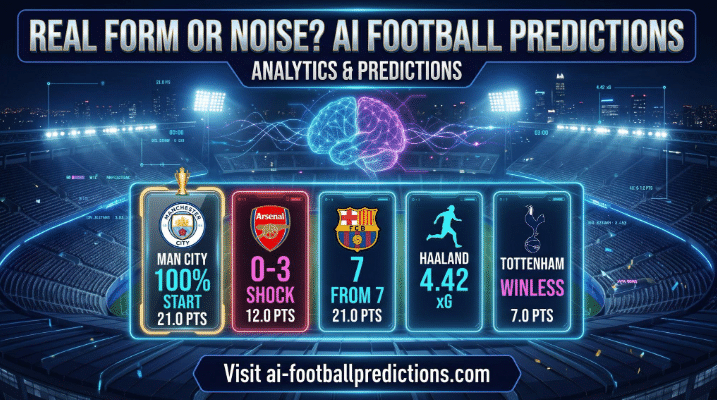
In the Premier League, Manchester City head into the international break as the only team with a 100% record, while defending champions Arsenal won their first four games before a shock 3-0 defeat at Brighton.
Further down the table, Tottenham, Bournemouth and Fulham were all still winless after five matches, while Brentford have again been punching above their weight.
In Spain, Barcelona have won all seven La Liga games, but Real Madrid have already lost twice despite José Mourinho’s return and a busy summer in the transfer market.
Why Early Results Can Mislead
Five or seven matches are a very small sample. A single red card, a penalty decision or an unusually good goalkeeping display can change a result, and in a short run those moments carry enormous weight. Over a full season those random moments tend to balance out, but after a few rounds they can badly distort the table.
Fixture difficulty also matters. A team that has played three of the league’s weakest sides may look stronger than it really is, while a side that faced several top opponents may be underrated.
This is why one heavy defeat, like Arsenal’s loss at Brighton, should not automatically change long-term expectations for a squad that won the title last season.
How AI Models Separate Signal From Noise
AI models are designed to look beyond the scoreline. Instead of focusing only on points, they analyse expected goals, shot volume, chance quality, defensive numbers and the strength of opposition.
Erling Haaland’s start is a good example. His five league goals came from 4.42 expected goals and a division-high 20 shots, with no penalties. That suggests his output is sustainable rather than lucky.
The opposite pattern is equally useful. A team collecting points while creating few chances may be riding a hot streak, and data can flag that risk before the results turn.
AI Football Predictions and Betting Value
The biggest opportunities often appear when the market and the underlying data disagree.
If odds shorten sharply on a team after a lucky winning run, backing them may offer little value. If a strong side loses once and its price drifts, the market may be overreacting. Analytical outlets such as The Analyst publish model-based previews that show how probability-driven forecasting works in practice.
Still, AI predictions are not guarantees. Models cannot fully account for sudden injuries, dressing-room problems, tactical changes or a manager rotating his squad before a Champions League night.
Patience Is the Smartest Strategy
The first weeks of the season are exciting, but they rarely tell the whole story. Some early leaders will stay at the top, while others will fade as fixtures get tougher and squads are stretched.
For bettors, the key is balance. Use data to identify which teams are genuinely strong, use team news to confirm the picture, and avoid chasing results just because they look impressive in September.
The best football predictions come from combining numbers and context. Those who respect both are far more likely to find real value when the market gets carried away.


